2017-8-14 : Asteroid to shave past Earth on Oct 12: ESA By Mariette Le Roux Paris

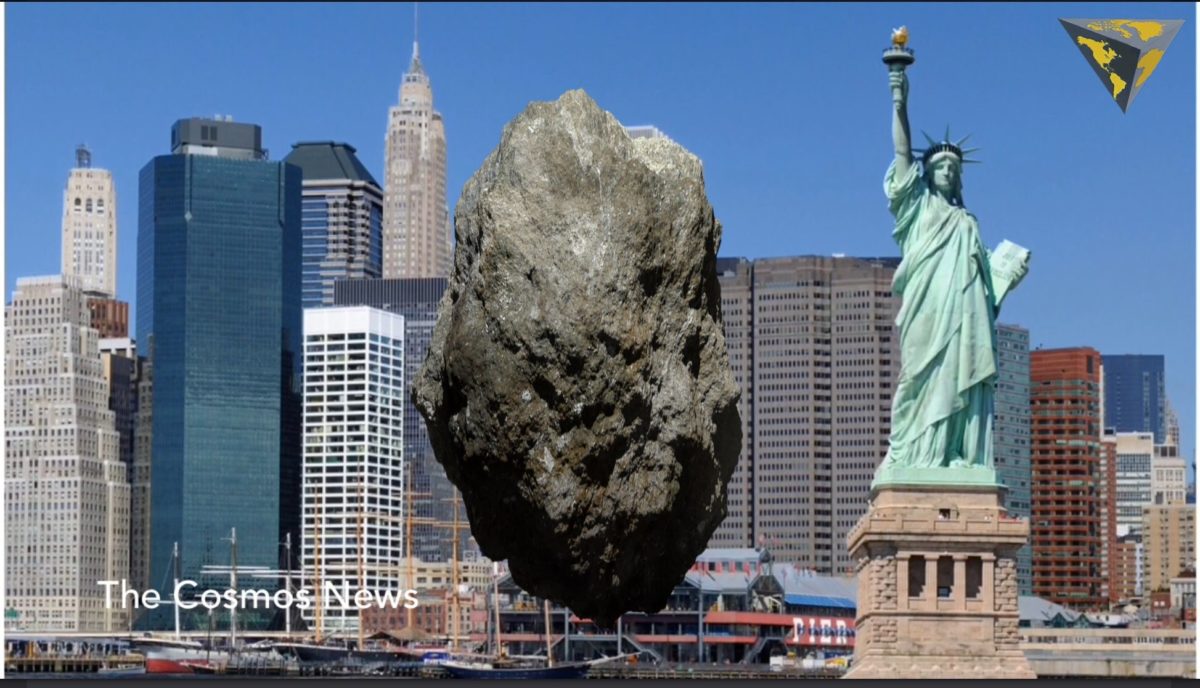
A house-sized asteroid will shave past our planet on October 12, far inside the Moon’s orbit but without posing any threat, astronomers said Thursday.  The space rock will zoom by harmlessly at a distance of about 44,000 kilometres (27,300 miles) — an eighth of the distance from the Earth to the Moon, according to the European Space Agency. This is just far enough to miss our geostationary satellites orbiting at about 36,000 kilometres.

“We know for sure that there is no possibility for this object to hit the Earth,” Detlef Koschny of ESA’s “Near Earth Objects” research team told AFP. There is no danger whatsoever.”

The asteroid, dubbed 2012 TC4, first flitted past our planet in October 2012 — at about double the distance — before disappearing from view.  It is about 15-30 metres (49-98 feet) long, and was travelling at a speed of some 14 kilometres (nine miles) per second when spotted.  Scientists expected the asteroid to return for a near-Earth rendezvous this year, but did not know how close it would get.  Now, the Very Large Telescope of the European Southern Observatory (ESO) in Chile has managed to track the rock down, some 56 million kilometres away, and determine its trajectory.

“It’s damn close,” said Rolf Densing, who heads the European Space Operations Centre in Darmstadt, Germany. “The farthest satellites are 36,000 kilometres out, so this is indeed a close miss,” he told AFP.

For researchers, the near miss will provide a rare chance to test Earth’s “planetary defence” systems — which at this point are focused on early warning rather than active asteroid deflection.

Observing TC4’s movements “is an excellent opportunity to test the international ability to detect and track near-Earth objects and assess our ability to respond together to a real asteroid threat,” said an ESA statement.  Asteroids are rocky bodies left over from the formation of our solar system some 4.5 billion years ago.  There are thought to be millions of them, most of them in a “belt” between the orbits of Mars and Jupiter.

A space rock slightly bigger than TC4, at 40 metres, caused the largest Earth impact in recent history when it exploded over Tunguska, Siberia, in 1908.

In 2013, a meteoroid of about 20 metres exploded in the atmosphere over the city of Chelyabinsk in central Russia with the kinetic energy of about 30 Hiroshima atom bombs.

The resulting shockwave blew out the windows of nearly 5,000 buildings and injured more than 1,200 people. It caught everyone unawares.

If an object the size of TC4 were to enter Earth’s atmosphere, “it would have a similar effect to the Chelyabinsk event,” said the ESA.

But Earth’s atmosphere stretches only a few hundred kilometres far, and TC4 will comfortably miss it. Also, it would likely behave very differently to the Chelyabinsk object.

“The Chelyabinsk meteoroid was a piece of comet and they are usually made of icy material,” said Densing. “Due to the icy nature it probably dissipated in the atmosphere… When we’re talking about asteroids, this is solid material. They are mostly made up of iron, so will not so easily dissipate their energy in the atmosphere.”

TC4 is unlikely to shed any debris into the atmosphere.

Even if it did, no evacuation would be required for an object this size, said Koschny, merely a warning for people to stay away from windows that could shatter from the shockwave.

Densing, who has previously warned that humanity is not ready to defend itself against an Earth-bound object, said he would not lose any sleep, not over this one.  “However, it makes you wonder what will happen next time,” he said.  “I would have felt a bit more comfortable if we… had a longer pre-warning time.”
READ MORE

2017-8-7 : Meteor Echoes Live Stream: livemeteors.com

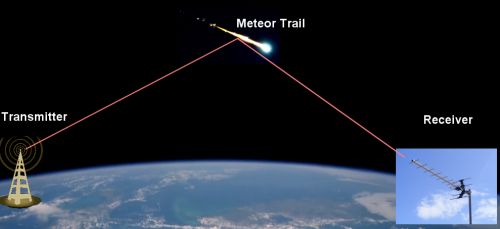
When a meteor enters the Earth’s upper atmosphere it excites the air molecules, producing a streak of light and leaving a trail of ionization (an elongated paraboloid) behind it tens of kilometers long. This ionized trail may persist for less than 1 second up to several minutes, occasionally. Occurring at heights of about 85 to 105 km (50-65 miles), this trail is capable of reflecting radio waves from transmitters located on the ground, similar to light reflecting from a mirrored surface. Meteor radio wave reflections are also called meteor echoes, or pings.

READ MORE

2017-8-5 : REPORTING SIGHTINGS

Reporting Sightings

QUICK REPORT : https://www.amsmeteors.org/members/imo/report_intro

Please capture sighting on video as quickly as you can possibly react.

General Guidance

A fireball is another term for a very bright meteor, generally brighter than magnitude -4, which is about the same magnitude of the planet Venus as seen in the morning or evening sky. A bolide is a special type of fireball which explodes in a bright terminal flash at its end, often with visible fragmentation.

If you happen to see one of these memorable events, we would ask that you report it here to the American Meteor Society, remembering as many details as possible. This will include things such as brightness, length across the sky, color, and duration (how long did it last), it is most helpful of the observer will mentally note the beginning and end points of the fireball with regard to background star constellations, or compass direction and angular elevation above the horizon.

Individual reports are shared with other interested organizations, and saved for statistical study purposes. Reports are also shared with the general public in the form of our Fireball Sightings Log, which allows visitors to monitor the fireball activity which is reported to us from across North America, over the course of a given year. Although the AMS does not pursue fireball reports with the intent of recovering meteorites, we do notify relevant planetary scientists when promising events occur in their local geographic areas, for them to pursue as they wish.

https://mufoncms.com/cgi-bin/report_handler.pl

Extra Canadian Reporting

Check : http://www.skyscan.ca/fireballs.htm

Feel free to phone at reasonable hours : 250-598-6692 in Victoria, BC


WT1190F Splashdown Friday

(Email from Cattle Point Dark Sky Urban Star Park volunteer William Smith)

Dear Gerhard Drolshagen : On the Orbit of WT1190F (aka Snoopy)

Does object  get captured weeks before and go into earth’s orbit, slowly losing speed and descending? OR does it come shooting directly into the earth’s atmosphere – almost perpendicular to a tangent  ie pointing at the earth’s centre?  This is important because if it orbits the earth one or two times as it slows down, then we might see it in the dark of the late evening where we are on West Coast of North America..

Look here :https://www.pinterest.com/pin/564357397034893195/


If you look at the ISS paths then focus in on the one which crosses southern India, this might indicate that SNOOPY (coming also NW-> SE) would pass over Panana, Bahamas, Northern Spain , Mediterranean and then IRAN . No luck for west coast of USA/Canada where I am.

Hello Bill,
Gerhard Drolshagen forwarded your message to me. Here is some of the info we have on WT1190F.

The object has been in Earth’s orbit at least since 2009. It has been moving in an elongated orbit with apogee at about twice the distance of the Moon, and perigee getting closer and closer to the Earth, until the upcoming re-entry. Since 2009, it has completed dozens of orbits around the Earth, and each orbit is about a month long.
The impact trajectory is not very vertical, but still much steeper than the typical re-entry of a low-orbiting satellite. It will come in with an angle of about 20° from the horizontal (=70° from vertical).

Given the fact that the orbit is so long, the geometry is totally different from a pass of the ISS. The latter orbits the Earth in about 90 minutes, while WT1190F takes weeks. So the current pass is actually the last part of the last orbit for this object.
Anyway, from a geometry point of view, it will definitely be observable from north America in the morning hours of November 12. However, it will be very faint, magnitude 19 or so, invisible by eye even with a large telescope. A CCD camera and at least a moderate-size telescope will be needed to get an image of it at that time.
Even for Europe and Northern Africa, which are the countries best-placed to observe it just hours before impact, it will only reach magnitude 15 or so, too faint for anything but images with a good telescope.

If you want to get an ephemeris for a specific site, I suggest you use this page from the Minor Planet Center:http://www.minorplanetcenter.net/iau/artsats/artsats.html. Just select WT1190F, enter the required information, and you will get your specific ephemeris based on the latest data.

Let us know if you need any additional info, and thanks for contacting us.
Marco

PS Young post-grads : http://hoyleshield.wesmith104.com/?page_id=80

For media : https://plus.google.com/communities/102562881766320685473


The AllSky Meteor Cam at the College of the Rockies in Cranbrook BC

AllSky Geminids Stack 11 Frames


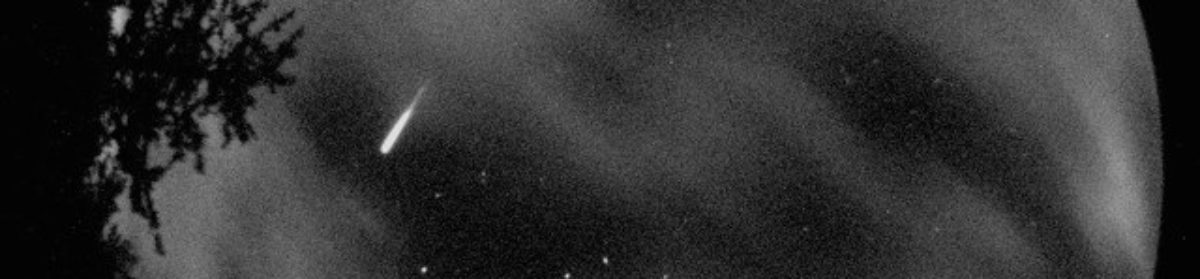
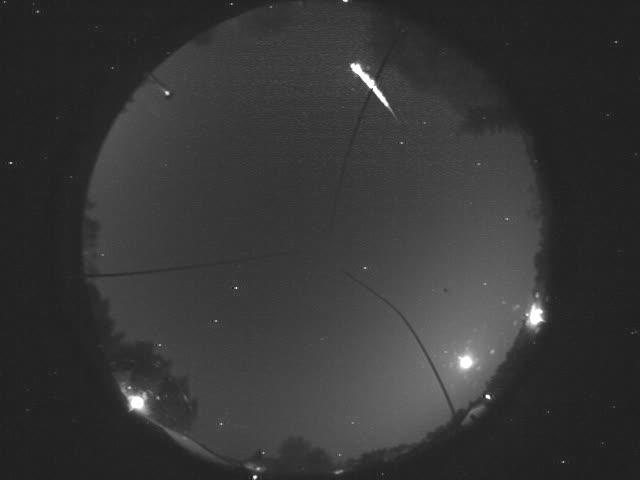
This is the College All-sky meteor cam showing the eleven brightest Dec 15 meteors stacked on one frame, from 7pm until 2am when it clouded over. North at top of photo and East to the left. Two bright fireballs on the horizon! That trail of dots there is Jupiter rising. Some clumps of dots are just aircraft strobes.

AllSky Geminids Stack 11 Frames


And here’s the 11 meteor stack for Dec 14 from 9pm until 1:15am, when it clouded over. About the same each evening.

Geminid Meteor StreakAnd just for fun, here’s all the photos stacked from the camera watching Ursa Minor over a 43 minute period, taken with 30 second exposures, 28mm f/2.5 lens, 1000 ISO.

Geminids from Invermere By Robert Ede

Geminids from Invermere

This photo was taken facing South, showing Orion before the Moon rose, from Invermere by Robert Ede. He says: I saw some beauties. A few with smoke trails.

2015-11-13 : WT1190F – Play by Play BLOG

015-11-13 : 10:21 PST. Splashdown was last night at 22:19  PST in SRI LANKA off coast of Matara. Was late evening on USA Westcoast Thursday. Please enjoy my Blog. This is a conversation between young post-grad scientist Subath Amaradasa of the “Near Earth Objects” Team at the University of Ruhuna, who is on ground with French scientists from European Space Agency and William Smith who is the Hoyle-Shield coordinator at Cattle Point DARK SKY Urban Star Park, Victoria, Canada.

PS There will be a post script to the Snoopy event. Snoopy is almost certainly the Apollo 10 lunar lander – aka Snoopy. Its orbit which reaches way past the moon, makes this almost certain. No wonder it burned out. Very high speed entering the upper atmosphere. Ten times the speed of the fastest bullet on earth. Being small and with no shielding, no wonder it quickly burned out. Thanks to Rick Nowell for inspiring Subath Amaradasa and his “Near Earth Object” team at the University of Ruhuna in Matara, Sri Lanka.

2014-12-20: Fireball Hits Near Canal Flats 20 Dec 2014

On the Hunt for rare rock after meteorite falls in December

University of Calgary geoscience professor asking for the public’s help.

A month after a spectacular fireball December 20, 2014, over the Rocky Mountains, University of Calgary researcher Alan Hildebrand is on a quest for rare meteorites.

In the early morning hours of December 20 a small piece of an asteroid entered Earth’s atmosphere high above Canal Flats, British Columbia, headed northeastwards towards Calgary, Alberta. Although western B.C. and eastern Alberta were overcast, the fireball was seen and imaged over the region between the clouds in both provinces. One spectacular still image was luckily taken by Brett Abernethy who was out with a friend imaging the night sky over Mt. Rundle near Banff when the fireball blazed an 80 km-long trail across the sky (See attached figure 1). Brett says, “We were looking north when everything lit up and we turned to see the fireball. It broke into at least three pieces and turned bright orange before fading away. After the initial shock I remembered that I was exposing a shot during the fireball and was overjoyed to discover that the shot was not overexposed.” Brett alerted the Calgary Herald to the event, who published his image which stimulated on-line discussion from other eyewitnesses.

Photo by Brett Abernathy

Fireball over Mt Rundle near Banff

In his search for more information about the fireball Hildebrand contacted Rick Nowell at the College of the Rockies in Cranbrook, B.C., who recorded it with his Sandia all-sky video camera through patchy clouds, and was able to correctly mark the fireball’s start time to precisely 00:25:00. With this accurate time, another all-sky still image was obtained from the University of Calgary’s Rothney Astrophysical Observatory (RAO). With these additional images in hand, he and his team were able to triangulate its location in the sky.

“It was very interesting to see how precisely a fireball path could be located just from two pictures taken more than 100 km away. We probably know where it was, start to finish within 100 metres,” says Lincoln Hanton, a recent University of Calgary graduate working with Hildebrand. The video recorded in Cranbrook and the fireball’s trajectory also show that it was a relatively slow entry velocity which favours the fall of meteorites.

Hildebrand says the fireball shows extraordinary properties. “In the photo taken by Brett, the fireball becomes visible at approximately 100 km altitude, starts fragmenting at approximately 60 km, and has its last and biggest explosion at 43 km. Those altitudes are much higher than normal. That means the rock was likely a weak type of asteroid.”

Rare carbonaceous chondrite rock

Hildebrand says the apparent weakness displayed indicates that this rock was unusual, probably a carbonaceous chondrite, which is a specific type of stony meteorite that originates from the Outer Asteroid Belt. At that distance from the Sun water and carbon-bearing compounds condensed and mixed into asteroidal bodies. Carbonaceous chondrites represent only approximately three per cent of meteorites that fall on Earth.

“Eyewitness accounts indicate that meteorites fell after surviving the trip through the atmosphere; the estimated rock mass entering the atmosphere was about 100 kg, but the largest pieces on the ground are probably only 2 kg,” says Hildebrand. “The meteorites fell in a forested area of the upper White River valley. It’s a tough area to search.” (See Figure 2)

Map of Impact Area

Satellite Map of Impact Area

Hildebrand says with the possibility of such a rare find his team will do some searching in the spring and encourage any others who can travel safely in this relatively remote area to search as well. How you can help

Hildebrand and his team are eager to talk with anyone who saw the fireball from Canal Flats, Fairmont Hot Springs, or Elkford, B.C. He encourages property owners in that region to check security camera systems for any shadows cast by the fireball. Anyone who had a wildlife camera in the region is also asked to check that date and time for moving shadows. Contact the University of Calgary at 403-220-8969 or via email at ltjhanto@ucalgary.ca.

 
Contact information:
Brett Abernethy   403-620-6929
Lincoln Hanton     403-220-8969
Alan Hildebrand   403-220-2291
Rick Nowell       250-489-2751 ext 3585

Figure 1: Brett Abernethy’s image of the Dec 20 fireball looking south over Mt. Rundle from near Johnson Lake. The fireball crossed the constellation of Orion and then began fragmenting where the trail brightens and broadens. Note the slight reddening at the fireball’s end as the surviving rock fragments slowed and cooled before falling to the ground. Image is a 40 second exposure taken with a Canon 5D Mark III with a wide angle Zeiss 21 mm lens which slightly compresses the vertical aspect of the image. (All rights reserved)

Figure 2: Satellite image of eastern British Columbia showing location of the fireball trajectory projected onto the ground and estimated meteorite fall area as a yellow ellipse. The end of the fireball was about 40 km east of Fairmont Hot Springs. An eyewitness in Canal Flats would have seen the fireball travel almost straight downwards in the sky. (Figure constructed on Google Earth base)