2006 06 A numerical method to aid

One of the biggest problem with forward scatter data is that each recording station is different from the others. One station might be using a highly directional yagi type antenna with it’s associated forward gain, while others might be using a simple vertical antenna. Others stations use a one wavelength closed loop, discones, or even quadafilar antennas. Each type of antenna places a certain bias on how many echoes are heard per hour.

In addition to the various antennas in use, radio observers also employ many different types of receivers. Some are state of the art while others are less sensitive and less selective than the more capable receivers. This again will influence the station’s daily data.

Yet an other variable among the stations it their frequency and transmitter choice. A few Japanese station listen to beacons on 28 MHz while several Europeans listen to the French satellite radar at 143.  Frequency choice and the transmitter’s output power  can greatly affect  a station’s data.

Recognizing this inter-station variability a few of us decided to attempt a numerical model to ‘level the playing field’ by using the concept of Observability Function. There will be follow ups to improve this initial modeling. It has been field tested and provides some hope on equalizing the data from such diverse stations.

The complete paper (WGN 34:3 p87-97) can be downloaded here.


2006 12 22 Outburst of Ursids


On December 22, 2006 The Ursid shower showed an above normal peak as reported by visual observers, all-sky video observers, and by radio observers. The outburst was predicted in CBET 77. The West Kelowna camera was under an overcast and did not record any captures. The radio data however did record earth passing through the predicted Ursid filament.

Here is the original telegram announcing our findings:


2006 01 04 The 2006 Quadrantids

The Quadrantid meteor shower is the first major shower of the new year. More importantly the shower is  a strong and reliable performer. It also happens to be one of the least observed stream of the major showers as early January usually produces low overcasting clouds whether you live in Asia, Europe or North America.

Unlike visual and video observers the low clouds and snow are no problem for radio observers. As the Quadrantid shower echo rates started increasing in West Kelowna, I started watching the live radio page at the RMOB site. I also visited the Japanese sites as well.

By observing these sites I could watch as the echo counts decreased in Europe as the radiant dipped downward, my numbers were on the increase. As mine were peaking the Japanese started seeing the radiant. As my data was taking hits from long duration, overdense echoes I made a note to see if I could make sense of the Quadrantid shower over both geographical space and through time.

I submitted my the results of my analysis to the editor of the WGN, the Journal of the International Meteor Organization. After being reviewed by others it was published. You can download a copy of the paper here.


2002 11 19 Leonids Outbreak

Hiroshi Ogawa, head of the International Project for Radio Meteor Observation,  asked radio detection stations from around the world to observe the Leonids during the period of November 1 to November 25, 2002.

Note: Brower was located in Loveland, Colorado at the time of the study and not in West Kelowna.

The following graph shows three stations located in Slovenia, USA, and Japan. The three stations data help trace  the overall activity of the 2002 Leonids.  Notice how as the radian lowered in the sky in Slovenia the radiant was rising for Colorado. Similarly, as the radiant dipped to the west of Colorado it was climbing higher in the sky in Japan, thus giving a continuous view of the overall stream activity over time.

FS Radio results Leo 2002

One of the most rewarding part of the 2002 Leonid study was the recording of a predicted filament  of the comet’s ejecta by Yrjöllä and Brower.

In chapter 14 of Jennniskens book, Meteor Showers and their Parents (Jenniskens 2006:201-215) gives a detail discussion of the filament and why it is important. He states:

Jupiter’s past perturbations may have responsible for the sudden onset of the component in 1994…
I expected the dust component would remain visible post perihelion for at least slightly less than one orbit of Jupiter (<12 yr), thus until 2004 or 2005.

I saw this validated in 2002, when the Filament component was detected for the first time after the perihelion passage of the comet, underlying two very narrow Leonid storm profiles (Fig. 14.41) The observed shift in the peak time and constant width over the years 1994 to 2002 (Table 4) confirms that this component moves about the earth’s path much like individual dust trails in reflection to the ever changing gravitational field of the planets (shaded area in Fig 14.15). Again, more or less following the sun’s reflex motion. (Ibid:214-215)

(Place Fig 14-41 Yrjöllä and Brower here)

More to come…

Jenniskens, P. 2006. Meteor Showers and their Parents, Cambridge University Press, Cambridge, U.K.

Welcome to the British Columbia Meteor Network

The British Columbia Meteor Network and its associate members are dedicated volunteers who have worked together to advance knowledge of meteor science. Some of our members are professionals although most are devoted amateurs.

The network is comprised of a video detection component as well as a radio detection component. We  share our data with multinational governments and astronomy groups.

Data collection is only one goal of the the network. We also hope to promote a strong educational program in open cooperation with the school districts and community colleges of British Columbia.

Feel free to browse our site. Likewise, feel free to contact us if you have any questions or would like to know more.

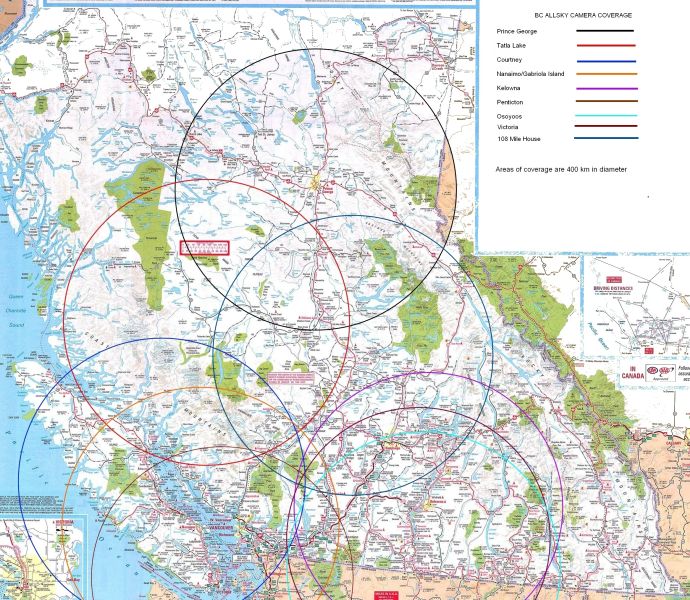
British Columbia Meteor Network Coverage Map


Click here to see the full resolution map.

For a brief history of how the network got started please read Ed’s article.