Fireball of Thursday 16 Mar 2017 at 9:39pm Pacific Time

A Meteor fireball fell over Central Washington State, and broke up over the Colville Reservation north of Yakima. The bright fireball was seen by many people from Vancouver Island , Vancouver, Seattle, and as far East as Spokane, Washington.  The American Meteor Society received 116 reports of “a fireball” over Washington, B.C., Idaho and Oregon.

Vancouver time that was  Thursday March 16, 2017 at 9:39pm.  People described a green tail turning briefly yellow, followed by a quick double flash at it broke up.  

 Kathy M. wrote on the  AMS site: “It was so amazing and beautiful. I’ve seen small, white falling stars before but never anything like this….large bright green with a huge white tail. Very cool.”  http://www.amsmeteors.org/members/imo_view/event/2017/1012

 Colour VIDEO:  Tammy Kwan, a Vancouver weekly newspaper Georgia Straight reporter, posted her dashcam video to YouTube she was driving on Lougheed Highway in Pitt Meadows.  See https://www.youtube.com/watch?v=xfcg_GiZhqA

Many of The Meteor Network All sky cameras across BC and Washington picked it up at 17 Mar 2017 at 04:39 UTC :

Bellview Wash (just a flash through clouds) at 04:39 UTC

 Victoria BC  at 04:39

Cranbrook Allsky Photo
Cranbrook Allsky

Cranbrook BC at 04:39; 

West Kelowna Allsky Photo
Kelowna Allsky
West Kelowna BC at 04:39.

Prince George BC at 04:53.  (Their clock may be out).

The Anarchist Mtn, and Richland, Wash sites weren’t online.  The Courtney BC site didn’t see it.

TRIANGULATION: On these Allsky photos, North is at the top, and East is on the left.  Knowing the location of the photos, and from their directions, we can triangulate where the meteor was.  If you get your ruler out and draw intersecting lines on a map, it appears South of Kelowna BC, in Central Washington, over the Colville Reservation.  In this case, it’s unlikely it hit the ground.

A second smaller meteor was seen to the North on 03/17/2017 at 04:53 UT, 14 minutes afterward.


Rocket Burns Up Over BC-Alberta Border Feb 24

Bright Slow-moving Disintegrating Object:

23 Feb 2015 at 10:56pm MST/9:56 PST

Shown above is an animated GIF of the rocket stage disintegrating as it passed over the Cranbrook, BC meteor-cam site. The Kelowna BC meteor-cam site caught a glimpse of it as well. The video frames displayed are 2 seconds apart over a 33 second period. It took a total of 83 seconds to pass overhead, coming in low like a comet over the Southeastern horizon, and leaving in four trailing chunks over the Northeastern horizon.

It was a highly visible fireball, with a long glowing tail with dozens of pieces sparkling and falling off. Many people in Cranbrook reported seeing it, phoning the radio station and enquiring at the airport. At first some wondered if it was a burning jet aircraft.

Neil Zeller in Calgary caught some good photos of it there. Check out this link here: Global News Article 24Feb2015

Rick Nowell

Bulletin

Reply-To: Ted Molczan
Re-entry of 2014-088B seen from U.S.A. and Canada

I awoke to a message from Joseph Remis with news that the re-entry of 2014-088B / 40363 had been seen from the western U.S. and Canada. It was stage 3 of the CZ-4B rocket that launched Yaogan Weixing 26 on 2014 Dec 27 UTC.

USSTRATCOM’s apparently final TIP message, issued at 11:15 UTC, reports the decay at 5:54 UTC +/- 7 min, near 42.3 N, 111.6 W. That corresponds to descent to 10 km, the approximate toe of the debris footprint (should any have survived to impact Earth). Based on the sightings, the final descent was farther north, well into Canada, but within the stated time uncertainty.

As I write, more than 140 observations have been reported to the AMS site: http://www.amsmeteors.org/members/imo_view/event/2015/451

The object was north-bound, descending from a 97.3 deg orbit. There are confirmed sightings from Arizona, Utah, Nevada, Wyoming, Idaho, Oregon, Washington, Montana, British Columbia, Alberta. The most southerly observation I have noted so far was from Scottsdale, Arizona; the most northerly from Didsbury, Alberta. That spans nearly 3000 km of the descent.

Map of Rocket Path_cropped
Map of Rocket Re-entry Path

I have plotted a large sample of the AMS sighting locations, along with the ground track of 14088B:

The underlying Google Earth kmz file is here: http://satobs.org/seesat_ref/misc/2014-088B_re-entry.kmz

Joseph provided a link to a video here: KSL 5 News in Utah

Report from Ted Molczan

Sentinel Camera Calibration

In December of 2008, after a series of back of the envelope type discussions on how to calibrate a Sentinel camera, Ken formalized the discussions in a pdf. To see Ken’s method Click here for Ken’s original paper on how we can calibrate the Sentinel camera.

As a footnote I (Jeff) did a work through with my camera system. After the spreadsheet was made and a small Python program run Ken took my results and plotted it to see how his model stood up. Here are those results.


Hi Jeff,

I could not resist having a quick look. Your data is lovely. I simply plotted

R = sqrt((x-x0)2+(y-y0)2)

against zenith angle.

In the first plot I assumed the camera zenith was (371,240), and in the second I optimized it, and got (370,231). This of course would be the camera zenith not the centre of the frame.

HOWEVER: Look at the nice clean plot and good correlation. I think you can use the camera zenith method and ignore trying to find the centre of the frame; they are obviously very close because the plot, including the very slight nonlinearity due to the fisheye effect, integrates so cleanly.

The very slight fisheye effect can be approximated more than adequately by a 2nd-order polynomial, as Martin Connors said it would.

I would say, for your system, you should be able to simply calculate R and use the equation to get the zenith angle, and then do a rotation to find the azimuth error…. job done.

Regards,

Ken


Radio Detection Basics

There are two primary methods being used by amateurs to detect meteors via forward-scatter technique; the FM method and the AM/CW method.

Prior to the 1960’s most of the radio meteor research was conducted at universities,  government and military sites. As it is now,  such institutions were limited by their current funding. This meant meteor observation were often spotty and they were not usually continuous over many days. They utilized radar and back-scatter techniques to detect meteors.

In the 1960’s amateur radio observers listened to a vacant commercial FM radio stations which have their channels in the 88-108 MHz range. As FM radio became more popular it quickly became harder and harder to find a vacant channel to listen for meteors. Even if a vacant was clear locally an observer might be plagued with the local stations’ ‘spilling over’ which  interferes with hearing meteors echoes. Since FM, frequency modulation, there is no easy way to see the Doppler signature of a meteor.

To avoid these limitations, crowding being the biggest problem, observers started using the video carriers of television stations. The video carriers are continuous wave (CW) and narrow band in nature. In North America each of the lower TV channels had one of three possible offsets; minus, zero, and a plus offset. What this means in practice is if channel 3 is an ’empty’ channel locally, then a listener could listen for the video carrier at 61.250 MHz (Zero offset), or on either side of it at 61.260 MHz (+ offset) or at 61.240 MHZ (- offset).  This provided an additional means of reducing possible interference. TV stations are also more spatially isolated than FM stations are so there is again, less chance of interference.

Compared to FM, using a CW signal also gives the observer a means of observing the Doppler signature of each echo by means of FFT (Fast Fourier Transform) routines. This enables studies on Epsilon type echoes, head echoes and other echo phenomenon. Using the Doppler of head echoes the height of a meteor can also be determined by amateurs.

Changes are in the wind

North American radio observers as well as European observers are facing a crisis. The video carrier method is on the verge of disappearing as the two continents switch from analogue TV signals to digital signals. The United States have already made the change and Canada is due in 2011. Many European stations have switched already while others linger on with analogue.

We will discuss alternatives signal sources to TV video carrier  below.

Forward-Scatter

Most people wonder how it is possible to hear a meteor. The answer is when a meteor enters the upper atmosphere it begins pushing atoms aside as it penetrates the ionosphere. These high speed collisions leads to high temperature heating of the meteor. When the energy becomes sufficient the meteor begins to glow at visible light wavelengths. Not  only does the leading front of the meteor glow it also creates a plasma trail behind it. We call this ablation. Mass is being converted into energy and light. The ionized plasma rapidly looses it’s energy and the electrons recombine so most meteors are a brief flash in the sky; the common shooting star we all knew as kids. Most of the visible phase of a meteor ablation occurs between 110 km and 60 km above earth’s surface.

The reason amateurs listen to TV video carriers or FM stations is because the stations provide the source of the RF, radio frequency, power that illuminates (reflects off) the meteor’s plasma trail. Commercial TV stations run 100,000 Watts (100 kW). That is a lot of power! While the stations want their signal to reach their customers’ TV sets in reality much of the signal is radiated out above the horizon and vertically into the sky itself. Usually these signals are lost to the sky as they penetrate the ionosphere without being reflected and continue out into space. If a meteor produces an ionized reflective trail then the VHF (TV and FM) signals can be reflected off the plasma and back down to earth. When the geometry is right radio observers receivers hear a brief “ping”; a musical sounding note of the signal reflecting off the meteor’s trail.

For forward-scatter work the transmitter is located well below the receiving station’s horizon. Usually we strive to have a transmitter between 600 to 1200 km away from the receiving site. See below for the geometry of forward scatter signals.

Diagram from Richardson and Knuteh (1998).

As mentioned, back-scatter is used by the professionals. In this case the receiving station is not below the horizon from the transmitter, rather, it is co-located with the transmitter. The power is borrowed as in forward-scatter it is produced by the transmitter at the site.  The signal is sent from the stations transmitter outwards and the signal is reflected back to the receiver at the same location. Radar is a prime example of back-scatter.

More to follow on video carrier method… For now please see ABMO Radio page to see examples of a working TV video carrier set-up.

Hopefully, one of our members will discuss using the FM method and it will be placed here. If you are interested in the FM I highly recommend going to Ilkka Yrjöllä’s web site.

Even if you’re not interested in FM detection his discussion on forward scatter is the best I’ve seen as is his discussion on CCD, light intensifiers and other meteor subjects.


Software for automatic counting section follows:

  1. Spectrum Lab
  2. mAnalyzer
  3. JAnalyzer
  4. HROftt
  5. Colorgramme Lab V 2.3
  6. Roll your own Colorgramme


Useful papers on Spectroscopy

Here are some useful papers that can be downloaded from ADS-Harvard and the IMO.

A Perseid Meteor Spectrum

Meteor Spectroscopy with Inexpensive Holographic Gratings

Canadian Scientists Report-XII Meteor Spectroscopy with Transmission Diffraction Gratings

Current trends in meteor spectroscopy

One hundred and fifteen years of meteor spectroscopy

High resolution spectra and monochromatic images of a flaring 1991 Perseid meteor (Using Reflection Gratings)

IMO Photographic Handbook part 3


2007 09 01 Aurigids Results

The 2007 NASA Aurigid Multi-Instrument Aircraft Campaign (MAC)


As a member of NASA’s Global Meteor Scatter Network I was asked to monitor the 2007 theta Θ-Aurigids shower. Dr. Peter Jenniskens of NASA  was conducting an elaborate airborne observation campaign, the Aurigid MAC.  Some of my radio data results for this campaign can be found on NASA’s Ames Research Center Aurigid MAC web pages.

Why was this shower important?

The shower is produced by the debris field from the passage of  Comet Kiess, C/1911 N1, over 2000 years earlier. The comet is long period comet; it made it’s first passage of the sun around 83 B.C. and competed it’s perihelion approach in 1911. It has been classified as a potential earth impactor. There have been other outbreaks in 1935, 1986, and 1994. Jenniskens and Lyytinen (2003) and Jenniskens and Vaubaillon (2007) predicted a strong outburst in 2007 lasting only an hour and a half. A pdf of the later can be found here.

The comet originated in the Oort cloud some 4.5 billion years ago. Gravity finally perturbed it enough to set it free from the cloud and sent it in bound for an orbit around the sun.

These are the preliminary results of the Aurigids as seen from Kelowna, British Columbia, Canada.

The station for this event consisted of two receivers and two antennas. My primary station listens at 61.260 MHz and uses an ICOM PCR-1000 software driven receiver was used with a 7 element log periodic antenna pointing due south. Counting software: Spectrum Lab FFT and mAnalyzer program.

My secondary station listens a 83.260 MHz an ICOM R-8500 receiver and a no gain, omni directional discone vertical were utilized. Counting software: mAnalyzer with 10 minute splits and Spectrum Lab running in parallel. Transmitters monitored were located in Bilings, Montana, and Bend, Oregon.

Saturation and Under Counts

The primary station began showing a decrease in echo counts starting at 1050 UT and continued depressed counts for about 60 minutes there after. This decline in echo counts was due to saturation, the overlapping of over dense echoes, keeping the software timers and counting routines triggered which led to some under counting the hourly echo counts. The secondary station is much less sensitive and as was hoped for, it did not have this problem during the peak shower.

Primary frequency 61.260 MHz, channel 3 plus offset,  shows the onset of long over dense echoes beginning at 1055 UT and continuing nearly 50 minutes. The recording starts at 0141 UT, blue ticks = 1 minute, red = 1 hour. For display, the spectrogram was set up to show only the brightest echoes, those equal to or stronger than 20 dB . The software  itself recorded all strengths of echoes from 10 dB, 20 dB, 30 dB, and greater than 30 dB  bins as well as the  the duration of each bin.

Brower's Aur outbreak

A very sharp increase in strong, overdense echoes began at 1050 UT. Based on the 10 minute data from both stations, the shower peaked around 1110-1125 UT, September1, 2007.

Results were summarized in CBET 1049:

Electronic Telegram No. 1049
Central Bureau for Astronomical Telegrams
INTERNATIONAL ASTRONOMICAL UNION
M.S. 18, Smithsonian Astrophysical Observatory, Cambridge, MA 02138, U.S.A.
IAUSUBS@CFA.HARVARD.EDU or FAX 617-495-7231 (subscriptions)
CBAT@CFA.HARVARD.EDU (science)
URL http://www.cfa.harvard.edu/iau/cbat.html

2007 AURIGID METEORS
P. Jenniskens, SETI Institute, reports that observations onboard
two research aircraft over Nevada and California indicate that the
anticipated Aurigid outburst (cf. CBET 1045) from the 1-revolution
dust trail of comet C/1911 N1 (Kiess) did occur on Sept. 1 between
10h30m and 12h00m UT, with a peak at 11h15m +/- 5 minutes (the predicted
peak time was 11h33m +/- 20 min).  The peak rate was within a factor of
two of that expected.  Most meteors were in the magnitude range -2 to +3,
as anticipated.
C. Steyaert, Vereniging Voor Sterrenkunde, Belgium, writes that
several stations of the ‘Radio Meteor Observatories On Line’ collaboration
(http://radio.data.free.fr/main.php3) report high Aurigid activity on
September 1.  A. Smith, Tavistock, U.K., observing at 143.050 MHz, found the
Aurigids to be “very active with big fireballs” between Sept. 1d10h45m
and 1d12h10m UT.  J. Brower, Kelowna, B.C., Canada, observing at 61.26 MHz,
found that “heavy, overdense echoes had a sudden onset starting” during
Sept. 1d10h50m-1d11h00m and continued to be heavy for an hour.  W. Camps,
Tessenderlo, Belgium, observing at 49.990 MHz, observed the following
counts at 10-minute intervals starting:  Sept. 1d10h00m, 6; 1d10h10m, 3;
1d10h20m, 4; 1d10h30m, 2; 1d10h40m, 4; 1d10h50m, 2; 1d11h00m, 7; 1d11h10m,
4; 1d11h20m, 7; 1d11h30m, 7; 1d11h40m, 3; 1d11h50m, 3; 1d12h00m, 4;
1d12h10m, 2; 1d12h20m, 2; 1d12h30m, 1; 1d12h40m, 1; 1d12h50m, 2.
J. M. Trigo-Rodriguez, Institut de Ciencies de l’Espai and Institut
d’Estudis Espacials de Catalunya, Bellaterra (Barcelona), reports that no
signs of Aurigid activity were recorded from Catalonia, Spain, via the
all-sky CCD cameras of the Spanish Meteor Network on Sept. 1d00h30m-
1d04h30m UT.  Meteors of magnitude 3 or brighter were recorded radiating
from the Aurigid radiant, and there were no signs of fireballs from the
dust trail of comet C/1911 N1.

NOTE: These ‘Central Bureau Electronic Telegrams’ are sometimes
superseded by text appearing later in the printed IAU Circulars.

(C) Copyright 2007 CBAT
2007 September 3                 (CBET 1049)              Daniel W. E. Green


Graphs Depiction of the outbreak at West Kelowna.

61.260 MHz Primary frequency Echo Count data:

multi61260_echo_10min

61.260 MHz Primary frequency Echo Duration data:

multi61260_dur

61.260 MHz Primary frequency Mean Echo Duration data:

multi61260mdur

83.260 MHz Secondary frequency Echo count data:

83260ma_10_echoes

83.260 MHz Secondary frequency Duration data:

83260ma_durs

83.260 MHz Secondary frequency Mean Duration data:

83260ma_10_meandur

Jenniskens, P., and J. Vaubaillon (2007), An Unusual Meteor Shower on 1 September 2007, Eos Trans. AGU, 88(32), doi:10.1029/2007EO320001.

Lyytinen, E., and Jenniskens (In press 2003), P. Meteor Outburst from Long-Period Comet Dust Trails. Icarus.

 

ABMO Radio Page

ABMO Radio Page

Latest radio meteor echoes from W Kelowna, B.C.

Highest none shower counts are at local sunrise and the lowest are at sunset.

Introduction

The observatory is located in West Kelowna and it uses the forward scatter technique of meteor echo detection. The receiver is tuned to TV channel 4’s video carrier frequency (negative offset) at 64.240 MHz. The echoes are from the video carriers of the two station listed below:


Station QTH Bearing km kW
CITL-TV Lloydminster, AB 56 770 130
CBKT-1 Moose Jaw, SK 81 975 100


When a meteor has the proper geometry between the transmitting TV station and the receiving station an echo is produced as the receiver as the signal is reflected off the ionized plasma produce while the meteor ablates in the earth’s upper atmosphere. The ionization usually occurs between 110 down to 60 km up, thus giving a radio coverage out to about 1400 km radius of the receiver.

The station consist of an Icom PCR-1000 to a seven element log periodic antenna. The antenna is installed in the attic and pointing 70 degrees or towards the northeast. A fifty foot piece of RG-58 coax connects the antenna to the receiver. No pre-amps are used. The PCR-1000 is a software controlled receiver; a small black box with only an on and off switch on the front.

ICOM PCR-1000


In the back of the PCR-1000 are:

BNC Antenna connector, a ground post, DC Input, Audio Out, a RS-238 connector for communication with the computer, and a special 9600 bps audio filtering bypass for high speed digital packet radio used on amateur built satellites (AMSAT).

Pin outs of the ICOM PCR-1000


During the major showers the observatory employs several different programs on several different computers on the LAN. Audio is split off the PCR-1000 as seen above (Y-adapter audio out) and shared among the computers during the showers. Alternatively, I use a second receiver, the ICOM R-8500 that runs in parallel with the PCR-1000 but on a different frequency, and run the audio from it to separate computer for real time analysis.

If a shower is predicted to show once in a lifetime activity I will also run an ICOM IC-746 transceiver. I usually devote the IC-746 to listening to 40.530 MHz, the US SNOTEL meteor system. SNOTEL has two master stations (transmitters) located in Utah and in Idaho which put in strong meteor burst signals into BC.

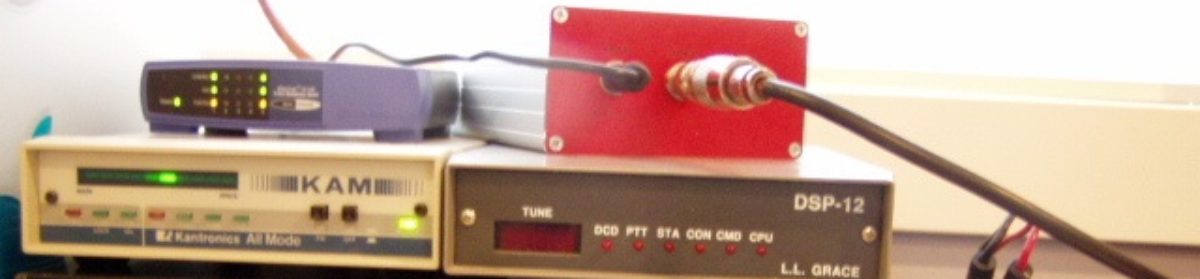
R8500 bottom and IC-746 middle HF homemade transceiver on top


The software does the actual detection, counting, data filing and display work.  Software in use includes Spectrum Lab, mAnalyzer, HROfft, all capable Windows programs. Watch for a software discussion in the Radio   Detection Basics in the Radio Methods section of the site. In addition to the above programs the observatory runs Janalyzer and a self written code. Which program is used is dependent on the subject understudy or nature of the shower.

Note: I do run the above programs on both Windows XP and on Linux machines. To see how I run it on a Linux machine please go to the RMOB site and read the article. Janalyzer is written in Java so is cross platform ready.

I set my software to output data at ten minute periods and on the hour. Depending on what software is running, duration for each 10 minute and hourly interval is recorded along with signal strengths in several bins of approximately 10 dB, 20 dB, 30 dB, and greater than 30 dB. Total time in seconds per period for each power level is also recorded.

A FFT spectrogram for each five minute period is ftp to an external site as well as saved on a local hard drive for study later or for the correlation with video fireballs

To be continued…