EMO Shower Spectroscopy Results

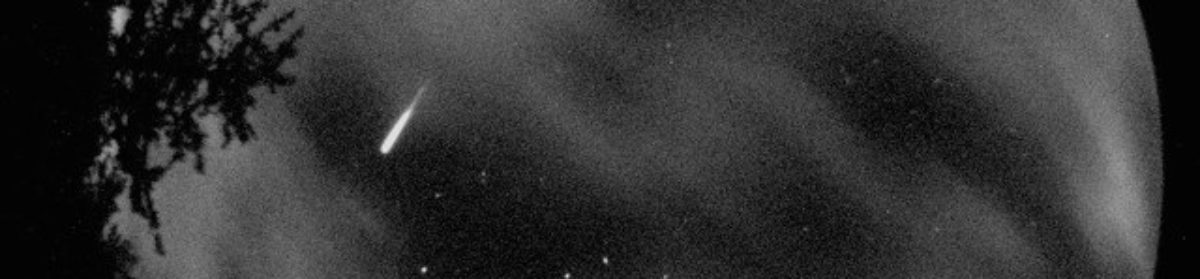
A typical Leonid meteor spectrum secured with an image intensified video spectrograph at EMO Courtenay, B.C. CANADA is shown below. This spectrum was secured using simple equipment. An experimental grade type MX9944/UV – 2nd generation 25 mm diameter image intensifier purchased on the surplus market was used. A standard Canon F-1.4 – 50 mm lens fitted with a precision 600 g/mm blazed B&L replica transmission diffraction grating imaged the spectrum on the image intensifier input screen.

The intensifier output screen was imaged by a Super 8 video camcorder recording on a standard  VHS recorder. The field of view is around 25 degrees. The “zero order” image of the meteor is on the extreme left. The “first order” spectrum is recorded with blue on the left with red to the right. The intensifier has rather limited sensitivity at the blue end so recorded lines are weak. Part of the red end of the spectrum was not recorded as it was off the screen to the right. The intensifier is mainly sensitive from around 450.0 nm to around 900.0 nm but as noted features below 450.0 nm are faint. Of special interest in this spectrum is the so called forbidden line of oxygen O I  3F recorded at 557.7 nm which is clearly recorded trailing the main spectrum. This line was first identified by Canadian astronomer, Ian Halliday in 1958. Earlier film spectra were reviewed and this was also found in an early Leonid spectrum designated as Number 29 on Millman’s World List of Meteor Spectra. See: R.A.S.C. Journal, Vol. 54, Number 4, p.189-192, August 1960.

This program was conducted on the morning of November 18, 2001. A total of 110 video meteor images were recorded during this program, 60 “zero order” images and 50 “1st order” spectra. A similar program was planned for 2002 but was unfortunately clouded out at my location.

I would like to thank Dr, Jiri Borovicka at Ondrejov Observatory in the Czech Republic for doing the scan of this spectrum.


Figure 1.  Leonid spectrum.  Time stamp is PST Pacific Standard Time +8 hrs for U.T.


Perseid Spectra

Figure 2.  Perseid Meteor Spectra


For comparison purposes a past Perseid meteor spectrum has been added.  It was secured with the same set-up as above. Frame capture was done on a MAC computer and saved in grey scale format.  The spectra scan is a composite carried out by Jiri Borovicka at Ondrejov Observatory.

Compare Perseid

Figure 3.  Perseid spectrum.  Time stamp is PDT  Pacific Daylight Time   + 7 hrs U.T.


Comare Fig 4

Figure 4. Sample of Photographic Meteor Spectra


Fig5 Perseid 1986

Figure 5. 1986 Perseid Meteor Spectrum with Objective Prism


Holographic TF

Figure 6. 8/9 June 1997 Holographic Thin Film Grating Spectrum

This sporadic meteor spectrum in Figure 6 was obtained using a Learning Technologies thin film holographic type grating. The spectrum is undergoing measurement by Dr. Josep M. Trigo Rodriguez of the Spanish Photographic Meteor Network. This is to establish whether these inexpensive type of gratings are useful for meteor spectroscopy by amateurs. The preliminary report was published by Ed Majden as a Research Note in the Journal of the Royal Astronomical Society of Canada: Vol 92: 91-92, 1998 April JRASC


Fig 7 spectra

Figure 7, 1983 Objective Prism Perseid Meteor Spectrum

A faint Perseid spectrum showing the O I forbidden line of Oxygen at 557.7 nm. Not published but sent to Peter M. Millman at NRCC for his evaluation. Sadly Dr. Millman passed away so I don’t know what became of the negative.

Edward Majden – R.A.S.C. Victoria Centre – A.M.S. Meteor Spectroscopy

EMO Courtenay B.C. CANADA Lat.49o 40′ 33.5″ N-Long. 125o 00′ 37.1 W (GPS)

2007 12 22 Ursid Outbreak

The 2007 Ursid Multi-Instrument Aircraft Campaign


In late December Jenniskens headed the 2007 MAC Ursid campaign. The shower is produced by ejecta from Comet 8P/Tuttle.

The Ursids shower of 2007 were predicted to peak between 2000 to 22:12 UT which favoured European observers. Radio observation
permitted me to observe the shower despite cloud cover and being on the wrong continent. As a station in NASA’s Global Meteor
Scatter Network, I submitted my initial radio data. The data from my forward scatter station, along those from others, were utilized Ames Research Center for analysis of the 2007 Ursid shower.

The shower was shakedown flight for the 2008 Quadrantid Multi-Instrument Aircraft Campaign, on January 3-4.


Electronic Telegram No. 1188
Central Bureau for Astronomical Telegrams
INTERNATIONAL ASTRONOMICAL UNION
M.S. 18, Smithsonian Astrophysical Observatory, Cambridge, MA 02138, U.S.A.
IAUSUBS@CFA.HARVARD.EDU or FAX 617-495-7231 (subscriptions)
CBAT@CFA.HARVARD.EDU (science)
URL http://www.cfa.harvard.edu/iau/cbat.html

URSID METEORS 2007
P. Jenniskens, SETI Institute, reports on elevated Ursid shower rates
between Dec. 22d18h and 23d01h UT, identified as dust ejected from comet
8P/Tuttle prior to 900 AD (cf. CBET 1159).  The outburst was detected in
radio forward-scatter meteor observations by E. Lyytinen (Helsinki, Finland)
during Dec. 22d18h-23d01h and by J. Brower (Vancouver, BC, Canada) during
Dec. 22d18h.5-22d22h.5.  I. Yrjola (Kuusankoski, Finland) reports that 25
Ursid meteors and 16 sporadic meteors were captured on video, with a peak at
around 21h15m, the Ursids being slightly brighter on average than other
meteors that night.
The International Meteor Organization gathered visual observations from
19 observers, who measured a peak ZHR = 34 ± 5 Ursids/hr (vs. predicted
40-70 meteors/hr) at solar longitude 270.53 ± 0.03 deg during Dec.
22d21h12m ± 42m, based on 116 Ursids (assuming a fixed population index
of chi = 2.5).  The predicted peak time was Dec. 22d20h-22d22h.2.

NOTE: These ‘Central Bureau Electronic Telegrams’ are sometimes
superseded by text appearing later in the printed IAU Circulars.

(C) Copyright 2007 CBAT

2007 December 31                 (CBET 1188)              Daniel W. E. Green

More to come…

ABMO Video Page

The observatory currently employs only one camera with a fish eye lens. The camera is mounted through the roof; it replaced a cap over a former aluminum chimney from a living room gas fireplace. The outside finger joints are sealed with silicon caulking preventing any water from entering the attic.  In the photo below a friend, Brent, shoots in true north with compass as I rotated the camera’s base from within the attic.

The lower end of the camera housing is inside the attic. I installed an AC outlet right next to it to power the camera and anti-dew heater. The black wire is the coax that carries the 1 Vp-p raw video signal down to the amplified video distribution box.

Attic side of it


The installment is complete and ready to observe.

Roof mount at W Kelowna

The raw video signal is sent from the rooftop down a coax to an amplified video distribution box (See below).

Video SPlitter

From the video splitter the video is then piped to a computer running the Python language program that came with the Sandi National Laboratories Sentinel camera. Since the original program was written in Python it can run on any operating system. The Sentinel software has been running flawlessly for three years on a very old, very slow, and very limited memory refurbished laptop running Linux. This software uses an external frame grabber as shown below.

Frame grabber Sentinel III

The video break out box also sends raw video to a second computer running the latest version of the Sentinel system. Unfortunately the next generation of the Sentinel system software is a Windows only – compiled software. It requires an internal PCI slot for an internal frame grabber. The board is a ImpactVCB model 188 board that comes with Hauppauge WinTV version 5.9G installation software.

model 188 Video card

The software is in early beta testing stage and bugs are being suppressed with each beta version.  Eventually the software will automatically ftp all overnight captures to New Mexico where the files will processed and analyzed for each observer. This feature is not yet implemented.

A third output of the video break out box is sent to a external Canopus ADVC-110 video to digital converter. The digital output from the ADVC is then sent by firewire to the computer where the UFOCapture program detects the meteors. To see an informative video about the ADVC-110 go here – It will take you to the  YouTube site and play the video.


More to come…

Student/Teacher Resources Page

To analyze meteor data with UFO Capture, refer to the instructions found under Video Analysis/Student UFO2 User Guide.

Download our Teacher Reference Documents (in PDF form) at our Downloads\References Section. These are collected from NASA, European Space Agency and other public sources.

There are three pages or more of files there: to switch pages click on the blue double arrows at the top right side of the page: “Page 1 of 3 >>” .

To download, put a checkmark in the boxes beside the files you want and hit “continue”. That should bring up a Download button, click that and it will download the PDF document into another browser window. (Note that some security filters may block this button, and show “[ad]” instead. To check, hover over that, you should see (for example) http://www.bcmeteors.net/downloads/finish/36/142.html, where 142 was the article number. Click on that [ad] icon to download it).

RASC Prince George Centre Observatory

RASC Prince George Centre Observatory (aka Prince George Astronomical Society) is located on Tedford Road in Prince George. It is a nonprofit organization dedicated to the advancement of astronomy and science in Prince George and the neighbouring Northern Canadian communities.

RASC Prince George Centre employs three methods of meteor detection


DETECTION USING AN FM CARRIER FREQUENCY


The RASC Prince George Centre has implemented a meteor detection project using information obtained from the Sky Scan Science Awareness Project and a program called Radio-SkyPipe. Two FM automobile radios tuned to 98.7 MHz, a Yagi antenna, and a Quadrifilar Helicoidal antenna, enable us to collect data and present it here in graph form.

Latest Radio-SkyPipe data


DETECTION USING A TV CARRIER FREQUENCY

The RASC Prince George Centre Observatory has associated itself with the International meteor detection organization called Radio Meteor Observatories On Line. Using the programs Spectrum Lab and Colorgramme RMOB lab, along with an ICOM IC-PCR1000 receiver tuned to Channel 3 video carrier frequency 61.240 MHz, we are able to collect data and present it here. Meteor activity on the left is in graph form for a 24 hour period. Data in the right hand box accumulates during the month and is colour based with blue signifying zero activity. Colours approaching red signify increased activity.


DETECTION USING AN ALLSKY VIDEO SYSTEM

RASC camera

The following image is the latest real time capture from the AllSky camera installed at the RASC Prince George Centre Observatory. This camera has a 180 degree field of view. North is up, West is to the right.

North Island College

Established in 1975, North Island College is now comprised of four campuses and four centres covering an area that includes northern Vancouver Island and the BC mainland coast from Desolation Sound to Swindle Island. The college offers over 800 courses and programs in health care, trades, business, fine arts, tourism, and university studies.

North Island College has a unique tie to Tatla Lake Elementary/Jr. Secondary School. With the assistance of the Tatlayoko Think Tank and others, an astronomical dome and telescope were installed on the school grounds.

The first observatory to be accessible via the internet in British Columbia, it is used by students of North Island College as part of the Space Science and Astronomy:Introduction to Deep Space Astronomy course.

Shane Observatory

Shane Observatory employs three methods of meteor detection

DETECTION USING AN FM CARRIER FREQUENCY

The Shane Observatory has implemented a meteor detection project using information obtained from the Sky Scan Science Awareness Project and a program called Radio-SkyPipe. Two FM automobile radios tuned to 98.7 MHz, a Yagi antenna, and a Quadrifilar Helicoidal antenna, enable us to collect data and present it here in graph form.

Current Radio-SkyPipe data

Current Radio-SkyPipe data


DETECTION USING A TV CARRIER FREQUENCY

The Shane Observatory has associated itself with the International meteor detection organization called Radio Meteor Observatories On Line. Using the programs Spectrum Lab and Colorgramme RMOB lab, along with an ICOM IC-PCR1000 receiver tuned to Channel 3 video carrier frequency 61.240 MHz, we are able to collect data and present it here. Meteor activity on the left is in graph form for a 24 hour period. Data in the right hand box accumulates during the month and is colour based with blue signifying zero activity. Colours approaching red signify increased activity.


DETECTION USING AN ALLSKY VIDEO SYSTEM

Shane camera

The following image is the latest real time capture from the AllSky camera installed at the Shane Observatory. This camera has a maximum 180 degree field of view. North is up, West is to the right.

Latest AllSky camera capture

RDL Observatory

Good Day All

This Observatory is somewhat active in visual astronomy however realistically I live in BC. This location has less than 68 days a year that are suitable for visually seeing and looking at stars.

Because of the reduced number of viewing days I first “Migrated to Simple Radio Astronomy Techniques” Namely a automotive FM radio tuned to a non used channel. in my case 98.7mhz.  A simple homemade antenna, and a software program called Radio Sky Pipe which using your PC and Windows generated and recorded a strip chart. Used for a few years perhaps 4 or so reactivated last week.

The next step up was to look at a form of passive radar.  Equipment used here differs from simple to more extensive and sophisticated radios ones, that are stable and will tune to television visual carrier frequencies.  Again using purpose written software “SpecLab”, the sound card of a PC, a simple antenna completes this project.

The above system uses a target TV station that is ~ 1500 km from the receiving site.  In my case the target is on the Saskatchewan/ Manitoba border. As the meteor enters the earths atmosphere at  105 to 95 km a plasma trail is generated which the target signal reflects off of giving me a characteristic ping the software decodes and presents it on a chart that is archived, it also generates a comma delimited file ready for importing in to spread sheets and other software programs. Because of a vary flaky internet connection to European areas I do not upload data to the RMOB site but submit data monthly to it for archival purposes.

Also on the active research list is the operation of two All Sky Cameras.  The first on line in the year 2005. A home built system comprised firstly of a PC164 camera, a Rainbow wide angle lens. and a  capture card. Tried many different software programs none being useful. Until attending a SSSP Star Party where Garry Dymond presented a discussion group with UFO Capture Software.  This was the Key to a successful capture program.  System has been revamped several time with up grades and changes. Latest configuration is Watec 902h u camera, a ADVC 55 digital video Converter. Dell GA280 computer plus the original purchased UFO capture software.

Next on line is a Sandia Sentinel system installed and operational about 4 months ago. It is the Sandia Mark IV configuration using a Sony 1/2″ camera, Rainbow lens, internal capture card, purpose written software and a Dell GA270 computer.  This system is coming along well.

Currently there is a 3.5 meter dish with a 9 element yagi antenna as a pick up point feeding a Icom PCR1000 radio on channel 67 with Radio Sky Pipe software ( in power ) detection mode attempting to detect Cassiopeia.  Also using Radio Eyes  Authored by Jim Sky  who is the author of Radio Sky Pipe software mentioned earlier. Results have been terrible so far.

73 wayne ve7duc