
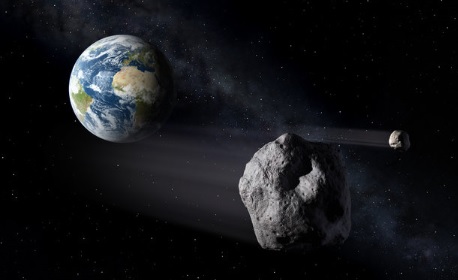
22 May 2013 : ESA today inaugurated a new hub that will strengthen Europe’s contribution to the global hunt for asteroids and other hazardous natural objects that may strike Earth.
Category: Latest
The latest news from the Joomla! Team
Canadian Meteor Orbit Radar (CMOR)
Each day approximately 4000-5000 individual meteoroid orbits are measured by CMOR – the amount of “clumpiness” in these radiants determines the location of individual showers.
{iframe width=”550″ height=”300″ }http://fireballs.ndc.nasa.gov/cmor-radiants/{/iframe}
Website Upgrade to Joomla 2.5 Completed

We have now migrated our website to Joomla 2.5. Please excuse us if there are any problems. Feel free to test the new site. We welcome you to report issues and suggestions to wesmith@outlook.com .
Click here to see more about our new design – Joomspirit template 75. Three of the good things with this template are :
- the template flexibility
- iPhone/iPad/Smartphone support (check it out)
- and the support of a brilliant graphics designer in France who designed the template and owns the 1 man company.
We plan to make this site very exciting. We also plan to add a video/image management plugin.
If anyone on the BCMeteors team knows a good logo designer, please let me know. We need a “logo refresh” 🙂
First Image from Cattle Point – RASC Victoria

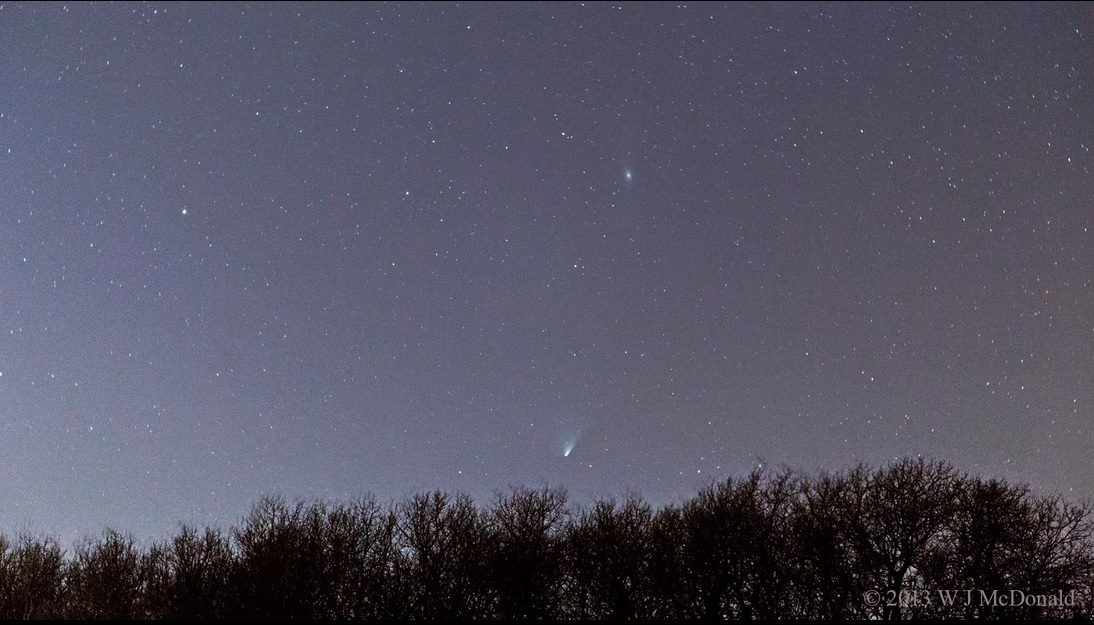
2013-03-31 at Cattle Point Urban Star Park in Victoria BC. First time at the newest Urban Dark Sky site in Canada. John McDonald captures the Comet Pan Starrs which is receding and not as bright as it has been. But still shows up nicely along with the Andromeda Galaxy in this wide field image.
Details
- Canon 6D with 24 to 105mm lens operating at 105mm.
- Exposure – 4 – 3.2s at ISO 6400 and f/4.
- Processing in Photoshop.
Click on Image below to see high resolution image.
Flying Over the Earth at Night
Many wonders are visible when flying over the Earth at night.
A compilation of such visual spectacles was captured recently from the International Space Station (ISS) and set to rousing music.
{youtube} FG0fTKAqZ5g {/youtube}
Cattle Point National Urban Star Park Approved
March 29, 2013 : Royal Astronomical Society of Canada approves the new CATTLE POINT NATIONAL URBAN STAR PARK which will be based in Oak Bay, Victoria, BC Canada. It’s unique low lighting provides a wonderful location for star gazing.
The popular picnic and birdwatching destination is approved by both Royal Astronomical Society of Canada and Oak Bay Municipality as one of the nation’s dark sky sites – there are 14 countryside “dark sky preserves” but only one other urban star park.
Mark Bohlman, an astronomy enthusiast who got his first telescope as a child, first presented Oak Bay council with the proposal last October 2012 and it was ultimately approved by council in January 2013. The Victoria branch of RASC after getting the go-ahead Friday from the national committee, now plans the implementation. Volunteers are encouraged to contact Mark Bohlman <mbohlman@shaw.ca> or Bill Smith at wesmith@outlook.com
Some Preliminary Ideas for the Park
- Website and SmartPhone app to match the park’s location and date/time – with audio narrative – for sample content see “Night Sky” by Rick Nowell.
- Cairns to match exact location of summer and winter solstice(s)
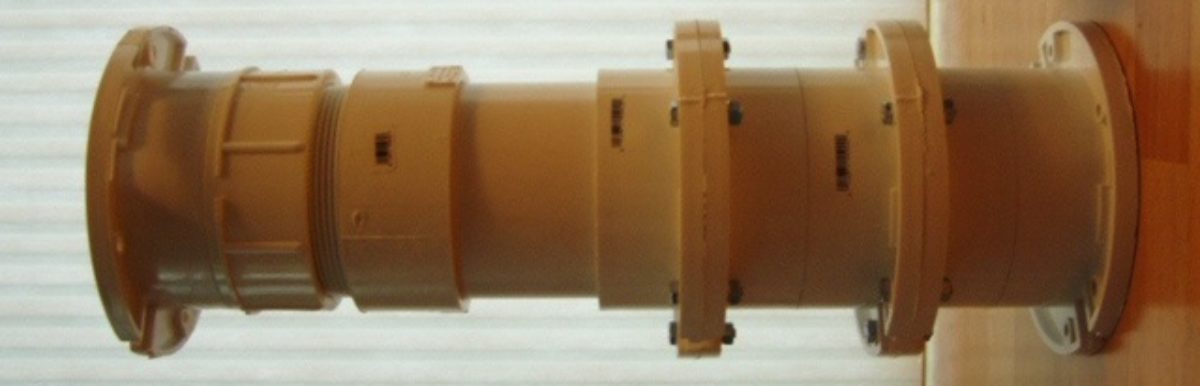
- Some extremely interesting construct – Below is vision of how a monolith might look (ala “2001 – a space odyssey”).
-
- Say 12 feet high.
- Granite or marble.
- Perhaps with creative use of glass
- Embedded solar powered PC +
- screen inside glass/granite remotely programmable
Goal is to create a great learning experience for students and tourists.
Ideas are already coming in fast and furious. These include a real-time app for the park perhaps linked to the world-wide telescope or a real telescope mounted in the park. Also planned is an iPhone app and use of “Google Glasses” for tourists and local visitors.
The possible engraved “monolith” (ala “2001 – a space odyssey”) if permission is given to erect, could be engraved with items like :
1) Burgess-Sagan’s Pioneer plaque – engraved

2)Engraved Pale Blue Dot speech: by Carl Sagan :
{youtube}wupToqz1e2g {/youtube}
3)Drakes Equation
N = R* fp ne fl fi fc L
where,
•N = The number of communicative civilizations
•R* = The rate of formation of suitable stars (stars such as our Sun)
•fp = The fraction of those stars with planets. (Current evidence indicates that planetary systems may be common for stars like the Sun.)
•ne = The number of Earth-like worlds per planetary system
•fl = The fraction of those Earth-like planets where life actually develops
•fi = The fraction of life sites where intelligence develops
•fc = The fraction of communicative planets (those on which electromagnetic communications technology develops)
•L = The “lifetime” of communicating civilizations
Frank Drake’s own current solution to the Drake Equation estimates 10,000 communicative civilizations in the Milky Way. Dr. Drake, who serves on the SETI League’s advisory board, has personally endorsed SETI’s planned all-sky survey.

Three Comets and an Asteroid in 2013
Three comets expected this year, two dim and one bright
Comet Pan-STARRS (C/2011 L4): visible March 5 until April 2013: this Comet will pass within one AU from the Earth as it proceeds onward to dip inside the orbit of Mercury. It is dim but visible with the unaided eye.
From Earth, the comet will appear close to the Sun, and it will only be observable briefly on the north-western horizon just after sunset, close to the crescent Moon on March 13. It’s only viewable for about 20 minutes, from about 8:15 until 8:40pm Mountain Daylight Time. The sky is too bright after sunset so you have to wait until about 8:15 when the sky darkens, but if there are mountains on the horizon, it will set below them within 15 or 20 minutes. It’s on the Northwest horizon, above Pegasus. It’s difficult to see at first, binoculars help a lot. It’s slowly moving North, by April 1 it will move closer to the Andromeda Galaxy.
Comet Pan-STARRS was discovered by the 1.8 meter telescope at the Panoramic Survey Telescope and Rapid Response System atop the Haleakala volcano in Hawaii, and named “Pan-STARRS” in it’s honour. It’s in a hyperbolic path, for orbital elements see JPL C/2011 L4
Comet Lemmon (C/2012 F6) already visible as a green blob in the Southern hemisphere, will be visible in the Northern hemisphere by April 2013 as it recedes back into the outer solar system on its 11,000-year orbit. Rather dim, it requires a telescope or binoculars to observe it. For orbital elements see JPL C/2012 F6
On November 2013: Comet ISON (C/2012 S1) could shine as brightly as a full Moon in broad daylight when it passes through the atmosphere of the sun. Although the comet is now only passing Jupiter’s orbit, more than 4.9 AU (763 million kilometers) from the sun, it already has a tail 64,400 km long. See JPL C/2012 S1
ISON was discovered on 21 Sept. 2012, by two Russian astronomers using the International Scientific Optical Network’s 16-inch telescope near Kislovodsk. And therefore named Comet ISON.
On 15 Feb 2013, Asteroid 2012 DA14, a 150-ft diameter stone skimmed by the Earth, passing inside the ring of geosynchronous satellites, 27,700 km above the Earth’s surface, before zipping back out into space at 7.8 km/s.
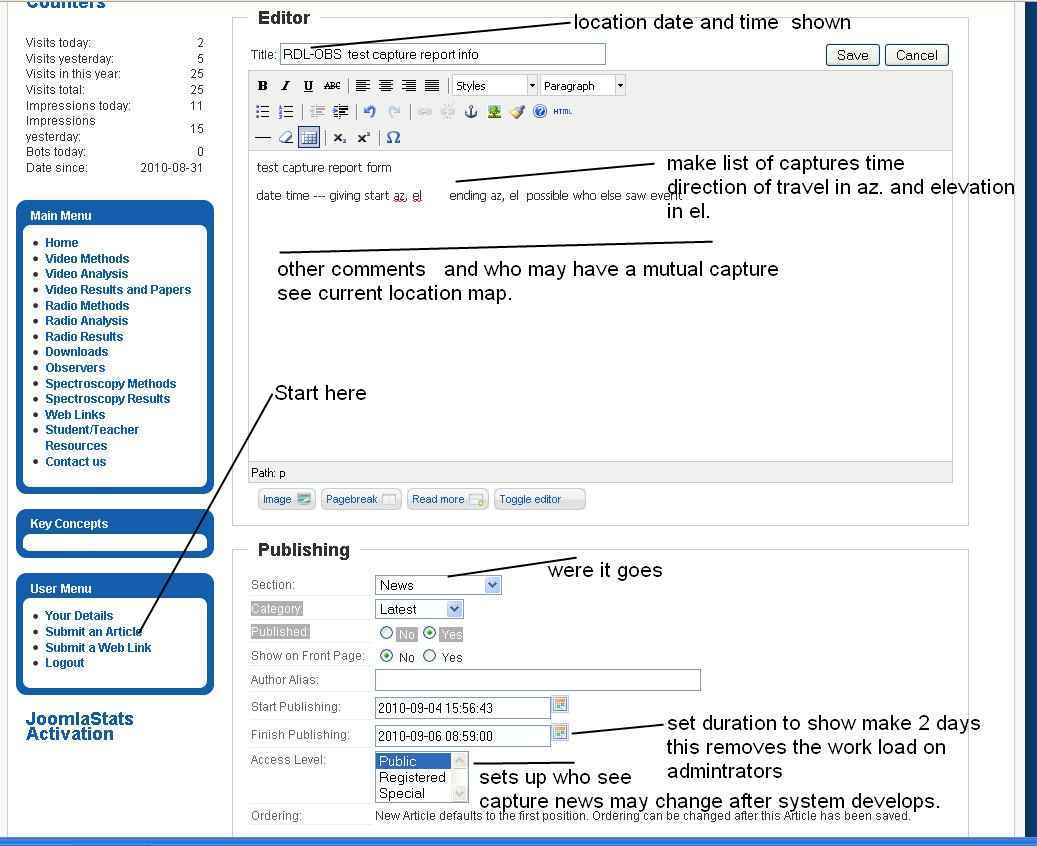
RDL-OBS how to report captures
Welcome Tatla Lake School
A special welcome to the Tatla School and it’s new video meteor camera! We look forward to working with you.
Welcome to the British Columbia Meteor Network
The British Columbia Meteor Network and its associate members are dedicated volunteers who have worked together to advance knowledge of meteor science. Some of our members are professionals although most are devoted amateurs.
The network is comprised of a video detection component as well as a radio detection component. We share our data with multinational governments and astronomy groups.
Data collection is only one goal of the the network. We also hope to promote a strong educational program in open cooperation with the school districts and community colleges of British Columbia.
Feel free to browse our site. Likewise, feel free to contact us if you have any questions or would like to know more.
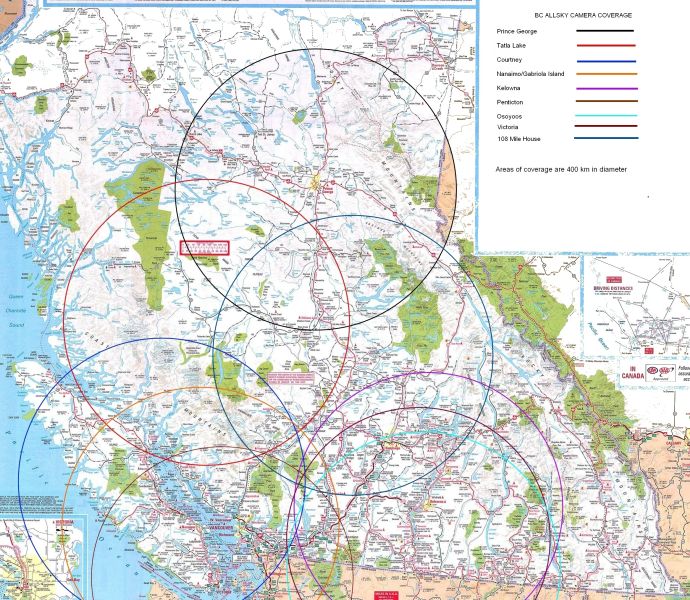
British Columbia Meteor Network Coverage Map
Click here to see the full resolution map.
For a brief history of how the network got started please read Ed’s article.