The Spectrographs used by Ed Majden

Here is some of the spectral equipment in use at EMO.

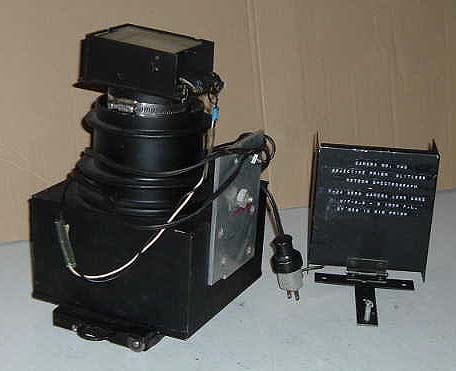
F-24 Aero Camera lens cone with an f-2.9 – 8 inch f.l Pentac lens fitted with a 27 deg 45′ objective prism with a refractive index of 1.71 for the 589 nm line. This unit has been modified to accept a 4X5 inch 6 platen Graphmatic film holder.


Two Camseras


Two, 2-1/4 X 2-1/4 inch roll film type cameras mounted with objective transmission gratings behind a chopping shutter.  The grey Camera is a Bronica and the other is a Hasselblad. An automatic system using used Hasselblad EL/M motor driven cameras is being worked on.


Video intensifier


This is a video image intensifier spectrograph recording system using a 2nd generation 25 mm MCP Image intensifier and a Canon L2 Super 8 – 1/2 inch format video camera. Such a system will record spectra as faint as +3.0 magnitude where photographic systems using film with standard lenses are limited to meteors brighter than -2.0 magnitude. This unit is still under construction. I have recorded several video spectra of Perseids and Leonids with a prototype system. Copies have been sent to Peter Jenniskens at SETI/NASA for his meteor spectra archives. Hopefully they will eventually be measured. Since 9/11 it is unfortunately difficult to get U.S. built 2nd and 3rd generation intensifiers unless you are a U.S. resident.


2007 12 22 Ursid Outbreak

The 2007 Ursid Multi-Instrument Aircraft Campaign


In late December Jenniskens headed the 2007 MAC Ursid campaign. The shower is produced by ejecta from Comet 8P/Tuttle.

The Ursids shower of 2007 were predicted to peak between 2000 to 22:12 UT which favoured European observers. Radio observation
permitted me to observe the shower despite cloud cover and being on the wrong continent. As a station in NASA’s Global Meteor
Scatter Network, I submitted my initial radio data. The data from my forward scatter station, along those from others, were utilized Ames Research Center for analysis of the 2007 Ursid shower.

The shower was shakedown flight for the 2008 Quadrantid Multi-Instrument Aircraft Campaign, on January 3-4.


Electronic Telegram No. 1188
Central Bureau for Astronomical Telegrams
INTERNATIONAL ASTRONOMICAL UNION
M.S. 18, Smithsonian Astrophysical Observatory, Cambridge, MA 02138, U.S.A.
IAUSUBS@CFA.HARVARD.EDU or FAX 617-495-7231 (subscriptions)
CBAT@CFA.HARVARD.EDU (science)
URL http://www.cfa.harvard.edu/iau/cbat.html

URSID METEORS 2007
P. Jenniskens, SETI Institute, reports on elevated Ursid shower rates
between Dec. 22d18h and 23d01h UT, identified as dust ejected from comet
8P/Tuttle prior to 900 AD (cf. CBET 1159).  The outburst was detected in
radio forward-scatter meteor observations by E. Lyytinen (Helsinki, Finland)
during Dec. 22d18h-23d01h and by J. Brower (Vancouver, BC, Canada) during
Dec. 22d18h.5-22d22h.5.  I. Yrjola (Kuusankoski, Finland) reports that 25
Ursid meteors and 16 sporadic meteors were captured on video, with a peak at
around 21h15m, the Ursids being slightly brighter on average than other
meteors that night.
The International Meteor Organization gathered visual observations from
19 observers, who measured a peak ZHR = 34 ± 5 Ursids/hr (vs. predicted
40-70 meteors/hr) at solar longitude 270.53 ± 0.03 deg during Dec.
22d21h12m ± 42m, based on 116 Ursids (assuming a fixed population index
of chi = 2.5).  The predicted peak time was Dec. 22d20h-22d22h.2.

NOTE: These ‘Central Bureau Electronic Telegrams’ are sometimes
superseded by text appearing later in the printed IAU Circulars.

(C) Copyright 2007 CBAT

2007 December 31                 (CBET 1188)              Daniel W. E. Green

More to come…

2007 09 01 Aurigids Results

The 2007 NASA Aurigid Multi-Instrument Aircraft Campaign (MAC)


As a member of NASA’s Global Meteor Scatter Network I was asked to monitor the 2007 theta Θ-Aurigids shower. Dr. Peter Jenniskens of NASA  was conducting an elaborate airborne observation campaign, the Aurigid MAC.  Some of my radio data results for this campaign can be found on NASA’s Ames Research Center Aurigid MAC web pages.

Why was this shower important?

The shower is produced by the debris field from the passage of  Comet Kiess, C/1911 N1, over 2000 years earlier. The comet is long period comet; it made it’s first passage of the sun around 83 B.C. and competed it’s perihelion approach in 1911. It has been classified as a potential earth impactor. There have been other outbreaks in 1935, 1986, and 1994. Jenniskens and Lyytinen (2003) and Jenniskens and Vaubaillon (2007) predicted a strong outburst in 2007 lasting only an hour and a half. A pdf of the later can be found here.

The comet originated in the Oort cloud some 4.5 billion years ago. Gravity finally perturbed it enough to set it free from the cloud and sent it in bound for an orbit around the sun.

These are the preliminary results of the Aurigids as seen from Kelowna, British Columbia, Canada.

The station for this event consisted of two receivers and two antennas. My primary station listens at 61.260 MHz and uses an ICOM PCR-1000 software driven receiver was used with a 7 element log periodic antenna pointing due south. Counting software: Spectrum Lab FFT and mAnalyzer program.

My secondary station listens a 83.260 MHz an ICOM R-8500 receiver and a no gain, omni directional discone vertical were utilized. Counting software: mAnalyzer with 10 minute splits and Spectrum Lab running in parallel. Transmitters monitored were located in Bilings, Montana, and Bend, Oregon.

Saturation and Under Counts

The primary station began showing a decrease in echo counts starting at 1050 UT and continued depressed counts for about 60 minutes there after. This decline in echo counts was due to saturation, the overlapping of over dense echoes, keeping the software timers and counting routines triggered which led to some under counting the hourly echo counts. The secondary station is much less sensitive and as was hoped for, it did not have this problem during the peak shower.

Primary frequency 61.260 MHz, channel 3 plus offset,  shows the onset of long over dense echoes beginning at 1055 UT and continuing nearly 50 minutes. The recording starts at 0141 UT, blue ticks = 1 minute, red = 1 hour. For display, the spectrogram was set up to show only the brightest echoes, those equal to or stronger than 20 dB . The software  itself recorded all strengths of echoes from 10 dB, 20 dB, 30 dB, and greater than 30 dB  bins as well as the  the duration of each bin.

Brower's Aur outbreak

A very sharp increase in strong, overdense echoes began at 1050 UT. Based on the 10 minute data from both stations, the shower peaked around 1110-1125 UT, September1, 2007.

Results were summarized in CBET 1049:

Electronic Telegram No. 1049
Central Bureau for Astronomical Telegrams
INTERNATIONAL ASTRONOMICAL UNION
M.S. 18, Smithsonian Astrophysical Observatory, Cambridge, MA 02138, U.S.A.
IAUSUBS@CFA.HARVARD.EDU or FAX 617-495-7231 (subscriptions)
CBAT@CFA.HARVARD.EDU (science)
URL http://www.cfa.harvard.edu/iau/cbat.html

2007 AURIGID METEORS
P. Jenniskens, SETI Institute, reports that observations onboard
two research aircraft over Nevada and California indicate that the
anticipated Aurigid outburst (cf. CBET 1045) from the 1-revolution
dust trail of comet C/1911 N1 (Kiess) did occur on Sept. 1 between
10h30m and 12h00m UT, with a peak at 11h15m +/- 5 minutes (the predicted
peak time was 11h33m +/- 20 min).  The peak rate was within a factor of
two of that expected.  Most meteors were in the magnitude range -2 to +3,
as anticipated.
C. Steyaert, Vereniging Voor Sterrenkunde, Belgium, writes that
several stations of the ‘Radio Meteor Observatories On Line’ collaboration
(http://radio.data.free.fr/main.php3) report high Aurigid activity on
September 1.  A. Smith, Tavistock, U.K., observing at 143.050 MHz, found the
Aurigids to be “very active with big fireballs” between Sept. 1d10h45m
and 1d12h10m UT.  J. Brower, Kelowna, B.C., Canada, observing at 61.26 MHz,
found that “heavy, overdense echoes had a sudden onset starting” during
Sept. 1d10h50m-1d11h00m and continued to be heavy for an hour.  W. Camps,
Tessenderlo, Belgium, observing at 49.990 MHz, observed the following
counts at 10-minute intervals starting:  Sept. 1d10h00m, 6; 1d10h10m, 3;
1d10h20m, 4; 1d10h30m, 2; 1d10h40m, 4; 1d10h50m, 2; 1d11h00m, 7; 1d11h10m,
4; 1d11h20m, 7; 1d11h30m, 7; 1d11h40m, 3; 1d11h50m, 3; 1d12h00m, 4;
1d12h10m, 2; 1d12h20m, 2; 1d12h30m, 1; 1d12h40m, 1; 1d12h50m, 2.
J. M. Trigo-Rodriguez, Institut de Ciencies de l’Espai and Institut
d’Estudis Espacials de Catalunya, Bellaterra (Barcelona), reports that no
signs of Aurigid activity were recorded from Catalonia, Spain, via the
all-sky CCD cameras of the Spanish Meteor Network on Sept. 1d00h30m-
1d04h30m UT.  Meteors of magnitude 3 or brighter were recorded radiating
from the Aurigid radiant, and there were no signs of fireballs from the
dust trail of comet C/1911 N1.

NOTE: These ‘Central Bureau Electronic Telegrams’ are sometimes
superseded by text appearing later in the printed IAU Circulars.

(C) Copyright 2007 CBAT
2007 September 3                 (CBET 1049)              Daniel W. E. Green


Graphs Depiction of the outbreak at West Kelowna.

61.260 MHz Primary frequency Echo Count data:

multi61260_echo_10min

61.260 MHz Primary frequency Echo Duration data:

multi61260_dur

61.260 MHz Primary frequency Mean Echo Duration data:

multi61260mdur

83.260 MHz Secondary frequency Echo count data:

83260ma_10_echoes

83.260 MHz Secondary frequency Duration data:

83260ma_durs

83.260 MHz Secondary frequency Mean Duration data:

83260ma_10_meandur

Jenniskens, P., and J. Vaubaillon (2007), An Unusual Meteor Shower on 1 September 2007, Eos Trans. AGU, 88(32), doi:10.1029/2007EO320001.

Lyytinen, E., and Jenniskens (In press 2003), P. Meteor Outburst from Long-Period Comet Dust Trails. Icarus.

 

VLF and Meteors Links

Please check out these links for a discussion of VLF signatures from meteors:

Beech M, Brown P & Jones J, VLF detection of fireballs, Earth Moon & Planets (Netherlands), 68 (1995) 181.

Beech M, & Foschini, L., Leonid Electrophonic Bursters, Astronomy and Astrophysics 367, (2001), 1056.

Beech M, & Foschini, L., A space charge model for electrophonic bursters, Astronomy and Astrophysics 345 (1999) L27

Rault, Jean-L., On the potential meteors ELF/VLF radiations Perseids 2009 campaign. (2010)


Sentinel III system in photos

The Camera and Housing

The housing for the camera, the anti-dew heater, the thermostat, and fan are all housed inside a PVC tube and toilet flange.
As packed for shipping. Stands approximately 0.5 meter tall.

Top shipping end removed reveals the camera and baffle.

Top Baffle

The Rainbow L163VDC4P fisheye lens mounted on the camera body. Note the PVC stiffener rods with coax cable running through it..

fisheye lens

ABMO Video Page

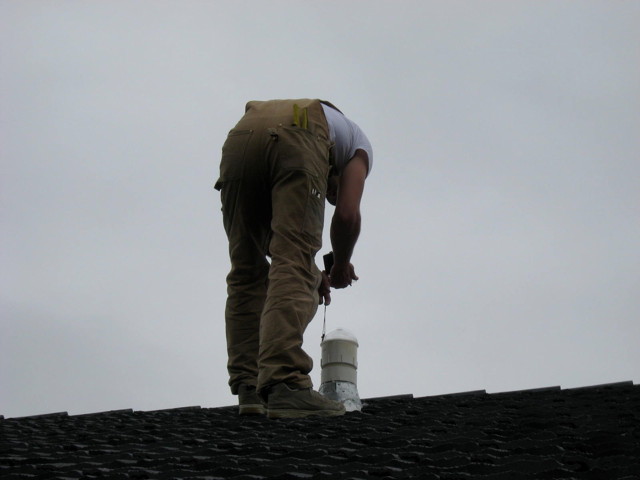
The observatory currently employs only one camera with a fish eye lens. The camera is mounted through the roof; it replaced a cap over a former aluminum chimney from a living room gas fireplace. The outside finger joints are sealed with silicon caulking preventing any water from entering the attic.  In the photo below a friend, Brent, shoots in true north with compass as I rotated the camera’s base from within the attic.

The lower end of the camera housing is inside the attic. I installed an AC outlet right next to it to power the camera and anti-dew heater. The black wire is the coax that carries the 1 Vp-p raw video signal down to the amplified video distribution box.

Attic side of it


The installment is complete and ready to observe.

Roof mount at W Kelowna

The raw video signal is sent from the rooftop down a coax to an amplified video distribution box (See below).

Video SPlitter

From the video splitter the video is then piped to a computer running the Python language program that came with the Sandi National Laboratories Sentinel camera. Since the original program was written in Python it can run on any operating system. The Sentinel software has been running flawlessly for three years on a very old, very slow, and very limited memory refurbished laptop running Linux. This software uses an external frame grabber as shown below.

Frame grabber Sentinel III

The video break out box also sends raw video to a second computer running the latest version of the Sentinel system. Unfortunately the next generation of the Sentinel system software is a Windows only – compiled software. It requires an internal PCI slot for an internal frame grabber. The board is a ImpactVCB model 188 board that comes with Hauppauge WinTV version 5.9G installation software.

model 188 Video card

The software is in early beta testing stage and bugs are being suppressed with each beta version.  Eventually the software will automatically ftp all overnight captures to New Mexico where the files will processed and analyzed for each observer. This feature is not yet implemented.

A third output of the video break out box is sent to a external Canopus ADVC-110 video to digital converter. The digital output from the ADVC is then sent by firewire to the computer where the UFOCapture program detects the meteors. To see an informative video about the ADVC-110 go here – It will take you to the  YouTube site and play the video.


More to come…

ABMO Radio Page

ABMO Radio Page

Latest radio meteor echoes from W Kelowna, B.C.

Highest none shower counts are at local sunrise and the lowest are at sunset.

Introduction

The observatory is located in West Kelowna and it uses the forward scatter technique of meteor echo detection. The receiver is tuned to TV channel 4’s video carrier frequency (negative offset) at 64.240 MHz. The echoes are from the video carriers of the two station listed below:


Station QTH Bearing km kW
CITL-TV Lloydminster, AB 56 770 130
CBKT-1 Moose Jaw, SK 81 975 100


When a meteor has the proper geometry between the transmitting TV station and the receiving station an echo is produced as the receiver as the signal is reflected off the ionized plasma produce while the meteor ablates in the earth’s upper atmosphere. The ionization usually occurs between 110 down to 60 km up, thus giving a radio coverage out to about 1400 km radius of the receiver.

The station consist of an Icom PCR-1000 to a seven element log periodic antenna. The antenna is installed in the attic and pointing 70 degrees or towards the northeast. A fifty foot piece of RG-58 coax connects the antenna to the receiver. No pre-amps are used. The PCR-1000 is a software controlled receiver; a small black box with only an on and off switch on the front.

ICOM PCR-1000


In the back of the PCR-1000 are:

BNC Antenna connector, a ground post, DC Input, Audio Out, a RS-238 connector for communication with the computer, and a special 9600 bps audio filtering bypass for high speed digital packet radio used on amateur built satellites (AMSAT).

Pin outs of the ICOM PCR-1000


During the major showers the observatory employs several different programs on several different computers on the LAN. Audio is split off the PCR-1000 as seen above (Y-adapter audio out) and shared among the computers during the showers. Alternatively, I use a second receiver, the ICOM R-8500 that runs in parallel with the PCR-1000 but on a different frequency, and run the audio from it to separate computer for real time analysis.

If a shower is predicted to show once in a lifetime activity I will also run an ICOM IC-746 transceiver. I usually devote the IC-746 to listening to 40.530 MHz, the US SNOTEL meteor system. SNOTEL has two master stations (transmitters) located in Utah and in Idaho which put in strong meteor burst signals into BC.

R8500 bottom and IC-746 middle HF homemade transceiver on top


The software does the actual detection, counting, data filing and display work.  Software in use includes Spectrum Lab, mAnalyzer, HROfft, all capable Windows programs. Watch for a software discussion in the Radio   Detection Basics in the Radio Methods section of the site. In addition to the above programs the observatory runs Janalyzer and a self written code. Which program is used is dependent on the subject understudy or nature of the shower.

Note: I do run the above programs on both Windows XP and on Linux machines. To see how I run it on a Linux machine please go to the RMOB site and read the article. Janalyzer is written in Java so is cross platform ready.

I set my software to output data at ten minute periods and on the hour. Depending on what software is running, duration for each 10 minute and hourly interval is recorded along with signal strengths in several bins of approximately 10 dB, 20 dB, 30 dB, and greater than 30 dB. Total time in seconds per period for each power level is also recorded.

A FFT spectrogram for each five minute period is ftp to an external site as well as saved on a local hard drive for study later or for the correlation with video fireballs

To be continued…


Student/Teacher Resources Page

To analyze meteor data with UFO Capture, refer to the instructions found under Video Analysis/Student UFO2 User Guide.

Download our Teacher Reference Documents (in PDF form) at our Downloads\References Section. These are collected from NASA, European Space Agency and other public sources.

There are three pages or more of files there: to switch pages click on the blue double arrows at the top right side of the page: “Page 1 of 3 >>” .

To download, put a checkmark in the boxes beside the files you want and hit “continue”. That should bring up a Download button, click that and it will download the PDF document into another browser window. (Note that some security filters may block this button, and show “[ad]” instead. To check, hover over that, you should see (for example) http://www.bcmeteors.net/downloads/finish/36/142.html, where 142 was the article number. Click on that [ad] icon to download it).